
Fridtjof Nansen: The Forgotten Viking Superstar Who Became a Humanitarian Legend
In the late 19th century, Fridtjof Nansen was a global superstar. World champion ice skater, Norwegian ski champion, the first person to cross the Greenland ice cap, and the man who got closer to the North Pole than anyone before him—he was the ultimate adventurer. Jules Verne wrote him fan letters. Sigmund Freud dreamed that Nansen saved him. In Norway, he embodied the nation itself: a tall, blue-eyed Viking with an impressive physique and an irresistible charisma.

Today, his name is far less known outside specialist circles. Yet Nansen’s life was extraordinary—not just for his daring polar feats, but for how he later turned his fame into one of the most important humanitarian legacies of the 20th century. He won the Nobel Peace Prize in 1922 for his work with refugees and prisoners of war after World War I, and he created the famous “Nansen Passport” that gave legal identity to hundreds of thousands of stateless people. This is the story of a man who lived at the extremes of human endurance and then dedicated himself to helping those broken by war and empire collapse.
A Student’s Spark of Adventure
Born in 1861 near Christiania (now Oslo), Norway, Fridtjof Nansen grew up in a comfortable family with a strong tradition of public service. Summers were spent hunting and learning survival skills; winters were dominated by skiing. He studied zoology at university and, at age 20, took what was supposed to be a one-month summer job on the sealing ship Viking. The vessel got trapped in the ice off Greenland for three weeks. Staring at the unknown white expanse, the young student caught the polar bug for life.
Nobody had ever crossed Greenland’s ice cap. In 1887 Nansen boldly proposed the idea to his university, only to be dismissed. Undeterred, he found a Danish patron and began meticulous planning. Everything had to be lightweight and self-sufficient: reindeer-skin sleeping bags for three men each, a small stove to melt ice for water, and pemmican-style preserved meat. Alcohol was banned to keep the team disciplined. In 1888, with five companions, he set off from a point 200 km south of the planned start after their ship was delayed by pack ice. They landed on the east coast and began the grueling westward trek.

For five weeks they endured temperatures of minus 40°C, violent storms where they could barely see the sled five meters ahead, and a landscape of crevasses and blinding white. They reached the 2,719-meter-high plateau, then descended toward Godthåb (today’s Nuuk). After 500 km of unknown territory in two months, they emerged as national heroes. The expedition proved that small, mobile teams using skis and sleds could succeed where large, cumbersome parties had failed. It also delivered valuable scientific data on ice thickness, meteorology, and geography.
The Legendary Fram Expedition: Racing Toward the Pole
Buoyed by success, Nansen set his sights on the North Pole. A meteorologist’s theory based on wreckage from the American ship Jeannette—found on Greenland after drifting from Siberia—suggested a transpolar current. Nansen’s audacious plan: freeze a specially designed ship into the ice near Siberia and let the current carry it across the top of the world.
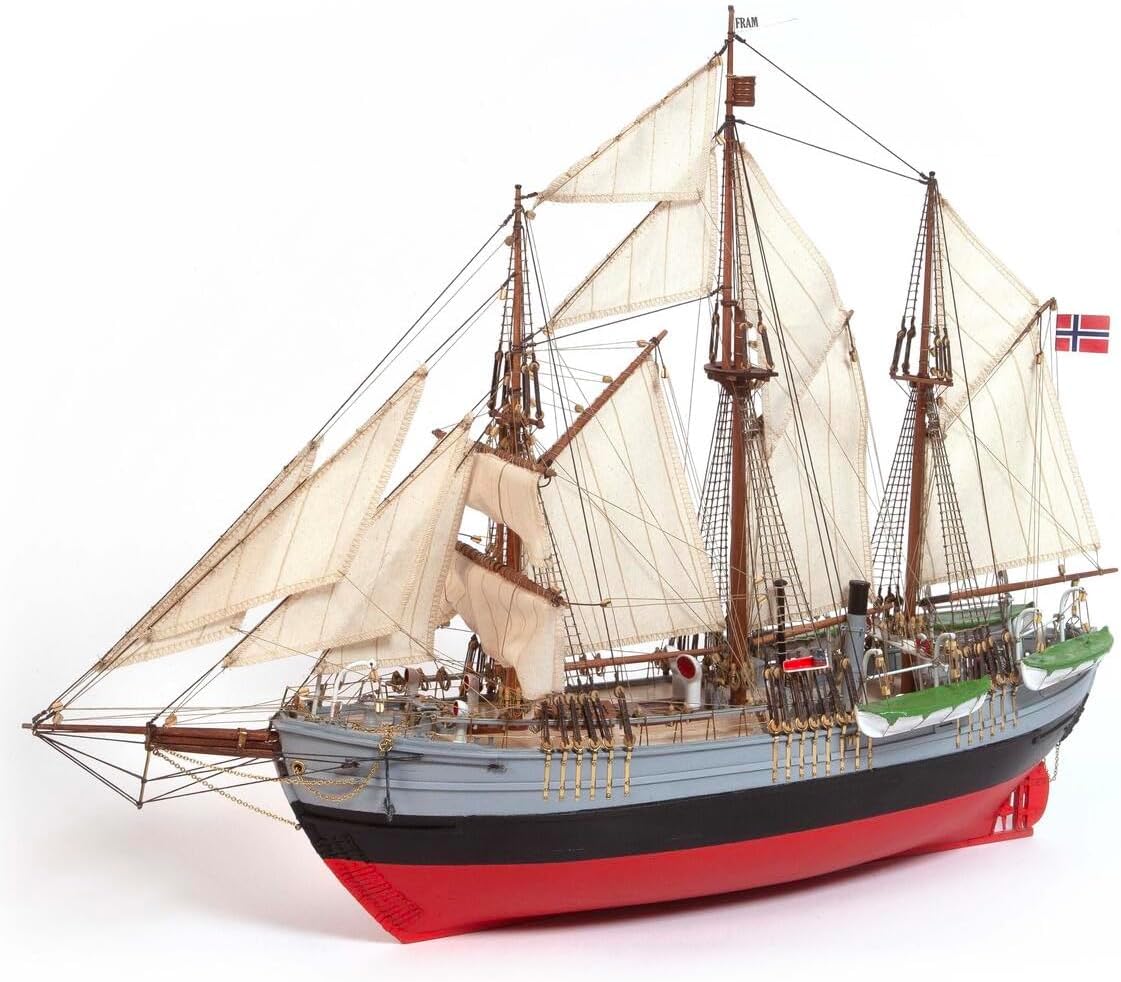
He commissioned the Fram (“Forward”), a vessel with a rounded hull engineered to rise out of crushing ice rather than be destroyed by it. In 1893, with a hand-picked crew of 12, including Hjalmar Johansen, Nansen sailed north. The Fram was deliberately locked into the pack ice off Siberia. For over a year it drifted—often southward—while the crew collected scientific data in relative comfort: heated cabins, good food, and artificial light.

When it became clear the current would not carry them directly over the Pole, Nansen and Johansen left the ship in March 1895 with sleds, dogs, and kayaks. They set a new “farthest north” record at 86°13′N—closer than any human had ever been. But the going was brutal: pressure ridges, open leads of water, and drifting ice that constantly threatened to separate them from safety. Realizing they could go no farther, they turned back.
Their retreat became an epic of survival. They lost their chronometers, making navigation nearly impossible. Summer warmth turned the ice into a treacherous maze. In August they reached land but knew they would have to winter over. The two men built a tiny stone hut—roughly two meters by three—with no windows. They spent eight months in total darkness during the polar night, surviving on bear and seal meat, battling boredom and isolation. In June 1896 they were miraculously rescued by a British expedition led by Frederick Jackson. The Fram itself eventually broke free and returned safely to Norway, validating Nansen’s current theory and delivering a treasure trove of scientific observations.
Amazon products inspired by Fridtjof Nansen's adventure

From Polar Hero to Global Statesman
The expeditions made Nansen a living legend, but he was far more than an adventurer. He was a gifted scientist (nearly won a Nobel in biology for his work on the nervous system), an accomplished artist who drew stunning auroras, and a writer whose books captivated the public. Yet he was also complex: driven by both rational inquiry and a deep aesthetic love of nature’s grandeur, yet plagued by self-doubt, melancholy, and a sense that he had never quite achieved enough.
After retiring from polar travel around age 40, he turned to diplomacy. When Norway gained independence from Sweden in 1905, Nansen served as ambassador to Britain. After World War I, the collapse of the Ottoman, Austro-Hungarian, German, and Russian empires left millions stateless. As Norway’s representative at the Paris Peace Conference, Nansen volunteered for humanitarian work. He organized the repatriation of roughly 430,000 prisoners of war—many from Russia—and coordinated famine relief in the Soviet Union.
His greatest contribution was the Nansen Passport, introduced in 1922: an internationally recognized travel document for refugees and the stateless. Issued to Russians, Armenians, and others stripped of citizenship, it allowed them to cross borders, work, and rebuild lives. By the time it was discontinued in 1942, more than 50 countries honored it; nearly 450,000 people had received one.

In 1922 the Nobel Committee awarded Nansen the Peace Prize “for his work in aiding refugees and prisoners of war.” He served as the League of Nations’ first High Commissioner for Refugees until his death in 1930 at age 69. Even after he was gone, the Nansen International Office for Refugees continued his mission and received its own Nobel Peace Prize in 1938. Today the UNHCR’s Nansen Refugee Award honors those who carry on his work.
A Lasting Legacy of Courage and Compassion
Nansen’s influence extended far beyond his own expeditions. He pioneered lightweight equipment, better clothing, diet, and sled design that later explorers like Roald Amundsen adopted. The Fram itself—now preserved in Oslo’s Fram Museum—was used by Amundsen for his triumphant South Pole journey. Mountains, a railway station in Russia, and even marine species bear his name. His innovations helped lay the foundations of modern polar exploration in an era before satellites and icebreakers.
Yet Nansen’s true greatness may lie in how he used his celebrity for humanity. In an age of colonialism where indigenous peoples were often dismissed, he treated the Inuit with deep respect, calling them intelligent, funny, and admirable. He believed politics must be rooted in “fraternal love, reciprocity, devotion, and trust.” His life shows that the same qualities that drive someone to the ends of the Earth—resilience, vision, and an unyielding belief in human potential—can also be turned toward healing a broken world.
Fridtjof Nansen never felt he had fully succeeded. He wrestled with self-doubt and the sense that he had spread himself too thin. But history judges him differently. He pushed the boundaries of exploration, advanced science, and—most importantly—restored dignity and hope to millions who had lost everything. In our own era of displacement and geopolitical upheaval, his story remains a powerful reminder: true heroism is not only about reaching the farthest north, but about ensuring no one is left behind in the cold.
(Word count: approximately 1,210)
AliExpress products inspired by Fridtjof Nansen


If the story of Fridtjof Nansen made you want to dive into the polar adventure or humanitarian history, do not hesitate to discover these objects inspired by his incredible heritage !